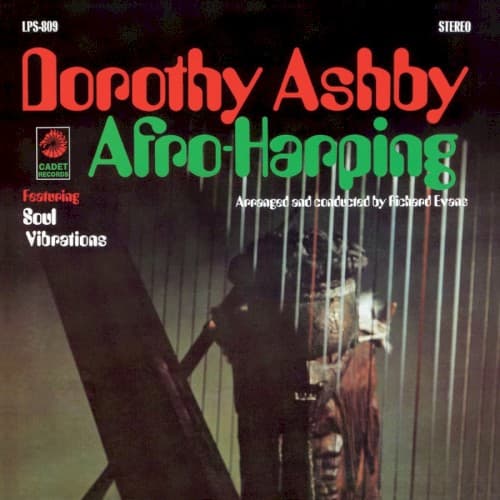
Afro‐Harping
Dorothy Ashby
1968 · Cadet Records · LPS 809

August 10, 2026 — August 16, 2026
Afro-Harping was recorded in February 1968 at Ter Mar Studios in Chicago and released that year on Cadet Records. Dorothy Ashby is on harp, with an unidentified orchestra arranged and conducted by Richard Evans, who also produced the session. Rather than placing the harp inside a small jazz group, Evans built a much larger setting around it: strings, brass and reeds, layered percussion, guitars, bass, keyboards and electronic textures. By this point Ashby had already spent more than a decade establishing the harp as a viable improvising instrument in jazz. Afro-Harping moves that language into a different environment, closer to the late-1960s sound of Cadet: orchestral soul, funk, jazz and studio experimentation occupying the same record. Ashby remains the lead voice throughout, rather than becoming part of the decoration around the arrangements. The album opens with Richard Evans’ Soul Vibrations, followed by Ashby originals Games, Action Line and Life Has Its Trials. The title track, Afro-Harping, was written by Ashby with guitarist Phil Upchurch. The second half moves through Freddie Hubbard’s Little Sunflower and versions of Valley of the Dolls, Come Live With Me and Burt Bacharach and Hal David’s The Look of Love. That mixture of originals and contemporary material is part of what makes the record such a useful document of Ashby’s work. Her playing moves easily between melodic lines, improvisation and rhythmic figures while Evans continually changes the setting around her. The harp can sit against percussion on one track and orchestral writing on the next without losing its place at the centre of the music. The record has also had a particularly long life outside its original jazz context. Ashby’s music has been repeatedly sampled by later hip-hop and electronic producers; Afro-Harping in particular appears in work connected to artists including GZA, 9th Wonder, Mac Miller and Flying Lotus. That later history has helped make Ashby’s recordings part of an ongoing conversation between jazz, beat-making and contemporary music rather than simply records rediscovered from the late 1960s.


Listening with eren.pellan + 3 others
About the record
Tracklist
Personnel
[unknown]
performing orchestra
Dorothy Ashby
harp
Production
Doug Brand
recording
Richard Evans
arranger, conductor, producer
Play the album
Related links
ARTICLES, REVIEWS AND MORE...
Conversation
0No comments yet.