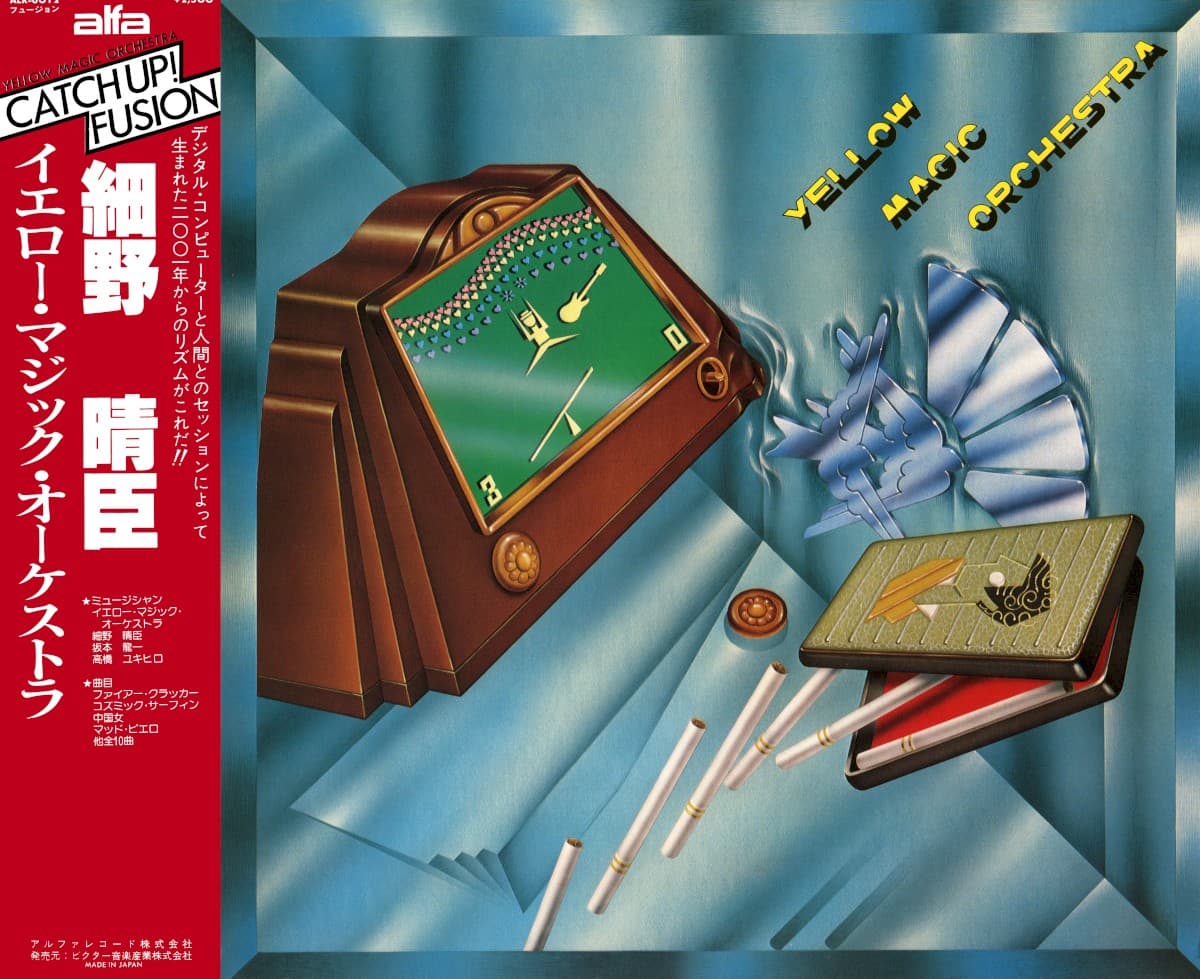
Yellow Magic Orchestra is the debut studio album by Japanese electronic music band Yellow Magic Orchestra. Originally released by Alfa Records, in Japan in 1978, the album was released by A&M Records in Europe and the United States and Canada in early 1979, with the US version featuring new cover art but without the closing track of "Acrobat". Both versions would later be re-issued in 2003 as a double-disc format, with the American version as the first disc. The album was an early example of synth-pop, a genre that the band helped pioneer. It contributed to the development of electro, hip hop, techno, and bleep techno. The album's innovations in electronic music included its use of the microprocessor-based Roland MC-8 Microcomposer music sequencer, which allowed the creation of new electronic sounds, and its sampling of video game sounds. The album sold 250,000 copies in Japan and entered the Billboard 200 and R&B Albums charts in the United States. Its most successful single was "Computer Game / Firecracker", which sold over 400,000 records in the United States and was a top 20 hit in the United Kingdom.
Production The album was intended to be a one-off project for producer and bass player Haruomi Hosono and the two session musicians he had hired: drummer Yukihiro Takahashi and keyboard player Ryuichi Sakamoto . The trio were to create their own cover version of Martin Denny 's 1959 exotica melody "Firecracker" with modern electronics, as a subversion of the exoticisation and Orientalism of the original tune, along with various original compositions also exploring themes of Asianness , exoticisation and Orientalism from a Japanese perspective. The album would eventually be called Yellow Magic Orchestra , as a satire of Japan's obsession with black magic at the time. The project proved highly popular, culminating in a career for the three musicians; one that would last until 1983, followed by successful solo careers and reunions over the decades to come. They began recording the album in July 1978 at a Shibaura studio in Tokyo . It utilized a wide variety of electronic music equipment (as well as electric), including the Roland MC-8 Microcomposer , the Korg PS-3100 polyphonic synthesizer , the Korg VC-10 vocoder , the Yamaha Drums and Syn-Drums electronic drum kits , the Moog III-C and Minimoog monosynths , the Polymoog and ARP Odyssey analog synthesizers , the Oberheim Eight Voice synthesizer , the Fender Rhodes electric piano , and the Fender Jazz Bass . Besides the electronic equipment, the only acoustic instruments used in the album were a Steinway piano, drum set, and a marimba . It was the earliest known popular music album to use the Roland MC-8 Microcomposer , which was programmed by Hideki Matsutake during recording sessions. The swingy funk element present throughout the album was expressed by Matsutake programming through subtle variations of the MC-8's input. At the time, Billboard noted that the use of such computer-based technology in conjunction with synthesizers allowed Yellow Magic Orchestra to create new sounds that were not possible until then. The band later described both the MC-8 and Matsutake as an "inevitable factor" in both their music production and live performances . The album was an early example of synth-pop , a genre that Yellow Magic Orchestra helped pioneer. Yellow Magic Orchestra experiments with different styles of electronic music, such as Asian melodies played over an "electro-disco" foundation in "Firecracker" and "Tong Poo", and the extensive use of video game sounds in "Computer Game". Both "Computer Game" tracks proper contain the same audio and were made to sound as if both games were being played in the same room; each track being from the perspective of its titular arcade game unit: Circus and Space Invaders . Both Circus and Space Invaders , along with several other popular arcade video games , were also featured in the promotional film for "Tong Poo".
Critical reception From contemporary reviews, Rosalind Russell of Record Mirror compared the group to Giorgio Moroder and Kraftwerk stating that the group "might resign themselves to coming a poor second", finding that the group's ethnicity and accents "may put off this nation's xenophobes. But who needs the UK? In the disco world we're small stakes anyway: the sons of Nihon are probably casting their eyes to the States and Germany."