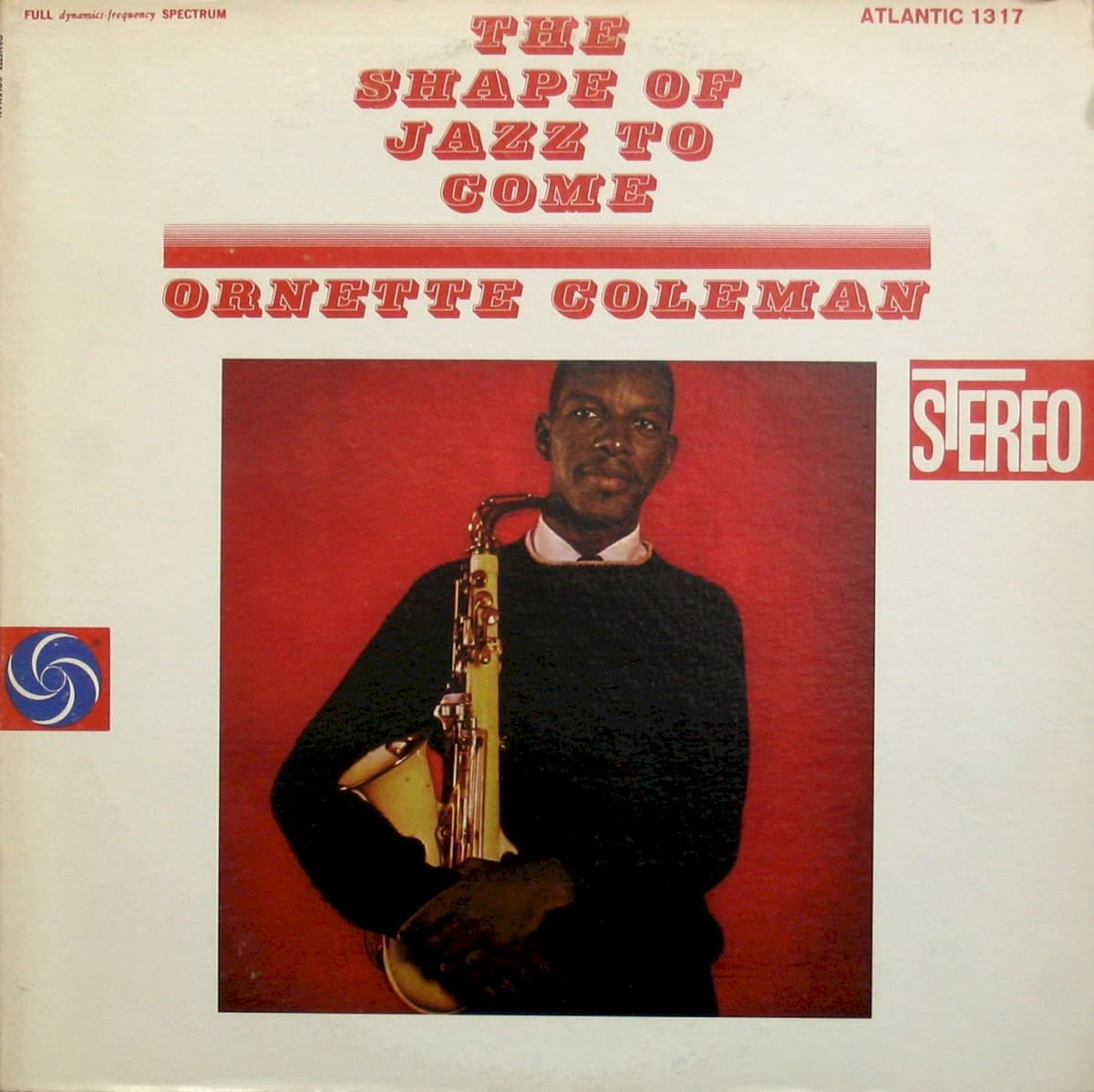
The Shape of Jazz to Come
Ornette Coleman
1959 · Atlantic · SD 1317

antenna
August 5, 2026 — September 5, 2026
Recorded in Los Angeles on May 22, 1959, The Shape of Jazz to Come features Ornette Coleman on alto saxophone, Don Cherry on cornet, Charlie Haden on bass, and Billy Higgins on drums. Without piano, the quartet opened more space around melody, rhythm, and collective improvisation, setting out an approach that would reshape the music in the years that followed.

Listening with nautnwe
About the record
The Shape of Jazz to Come is the third studio album by American jazz musician Ornette Coleman. Released on Atlantic Records in November 1959, it was his debut on the label and his first album featuring the quartet of himself, trumpeter Don Cherry, bassist Charlie Haden, and drummer Billy Higgins. The recording session for the album took place on May 22, 1959, at Radio Recorders in Hollywood. Although Coleman initially wished for the album to be titled Focus on Sanity after its fourth track, producer Nesuhi Ertegun suggested the final title, feeling that it would give consumers "an idea about the uniqueness of the LP." In 2012, the Library of Congress added The Shape of Jazz to Come to the National Recording Registry. The album was included in all three editions of the Rolling Stone list of the 500 greatest albums of all time. AllMusic called it one of the 20 essential free jazz albums. The album was inducted into the Grammy Hall of Fame in 2015.
Background From 1948 to 1958, Coleman moved between New Orleans , his hometown of Fort Worth, Texas , and Los Angeles , working various jobs and developing his own unique sound that was often met with hostility. His approach initially made it difficult for him to make ends meet by playing music. While employed as an elevator operator in Los Angeles, he studied music theory and harmony and developed an idiosyncratic take on country blues and folk forms. Coleman's big break came in Los Angeles when he caught the attention of bassist Percy Heath and pianist John Lewis of the Modern Jazz Quartet . Lewis encouraged Coleman and his trumpeter, Don Cherry, to attend the Lenox School of Jazz summer program in Massachusetts in 1959, at which Lewis was the director. Lewis also secured Coleman a deal with Atlantic Records, which paid his tuition at the Lenox School. Though both Coleman and Cherry were already rather accomplished by this point in their careers, Lewis wanted to use their attendance at Lenox to generate buzz amongst jazz circles. Their presence at the school was not without friction amongst students and faculty alike, but in the end, their attending the school accomplished what Lewis hoped to achieve. Coleman was subsequently booked by Lewis to play at the 1959 Monterey Jazz Festival in California. In June 1959, Coleman suggested to Atlantic jazz producer Nesuhi Ertegun that he was considering abandoning music in order to study religion. Ertegun, confident of Coleman's potential, urged him to reconsider.
Reception and legacy On November 17, 1959, shortly after the release of the album, Coleman's quartet began a residency at the Five Spot Café in Manhattan. Arranged by John Lewis, it was initially scheduled to last two weeks, but was eventually extended to 2 + 1 ⁄ 2 months. The performances were well-attended and generated controversy amongst attendees, critics, and jazz musicians alike. Some musicians and critics praised Coleman for an inventiveness not seen since the emergence of bebop, including Charles Mingus , who said: "It’s like organized disorganization or playing wrong right. It gets to you emotionally like a drummer." Others, including Miles Davis , were unimpressed. The album was ranked number 246 in Rolling Stone magazine's 2003 list of the 500 greatest albums of all time . The album's rank dropped to number 248 in the 2012 update of the list, and to number 417 in the 2020 update. In 2024, Paste magazine ranked The Shape of Jazz To Come number 231 on its list of the 300 Greatest Albums of All Time. The album was identified by Chris Kelsey in his AllMusic essay "Free Jazz: A Subjective History" as one of the 20 Essential Free Jazz Albums. In its ninth edition, The Penguin Guide to Jazz awarded the album a "crown" accolade, in addition to a four star rating. The album was inducted into the Grammy Hall of Fame in 2015. Two outtakes from the session, "Monk and the Nun" and "Just for You", would later be released respectively on the 1970s compilations Twins and The Art of the Improvisers .
Tracklist
A1Lonely Woman5:02
A2Eventually4:22
A3Peace9:04
B1Focus on Sanity6:52
B2Congeniality6:48
B3Chronology6:03
Personnel
Billy Higgins
drums (drum set)
Charlie Haden
double bass
Don Cherry
cornet
Ornette Coleman
alto saxophone
Production
Dayton “Bones” Howe
recording
Play the album
Related links
ARTICLES, REVIEWS AND MORE...
Conversation
0U
No comments yet.